Editorial Workflow
Academic Stack provides a sophisticated and flexible editorial workflow system tailored for the rigorous demands of academic journals and conference proceedings.
The system adheres to the established structures of scholarly publishing while offering extensive configuration options. This allows publishers to align the platform with their specific editorial policies, institutional requirements, and unique management styles.
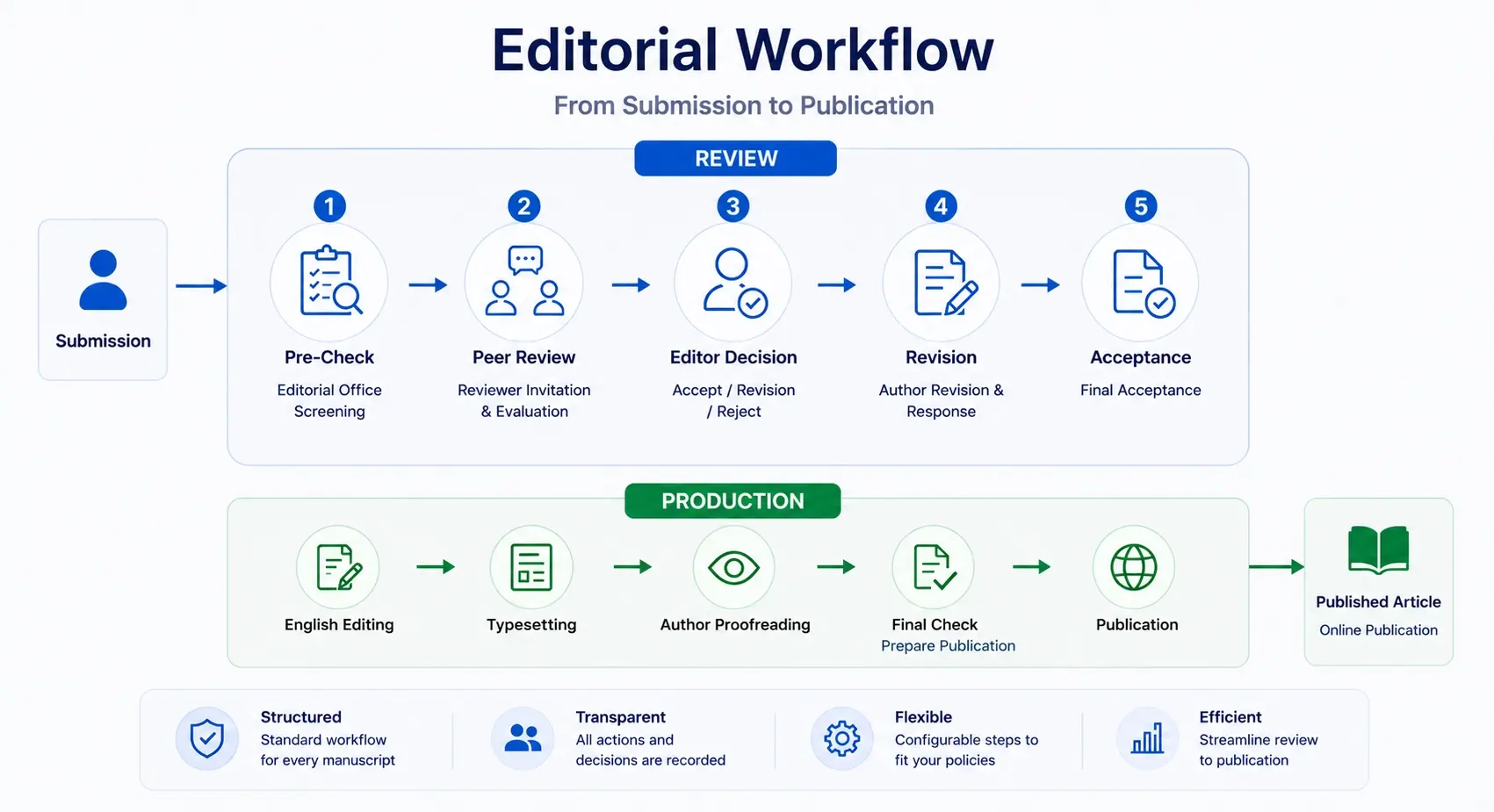
Academic Stack maintains a clear separation between invoice management and editorial workflows. The editorial office can generate one or more invoices at any stage of the article processing lifecycle. For a detailed look at financial workflows, see Billing & Invoices.
The Core Concept
Scholarly publishing thrives on continuous, structured communication between authors, reviewers, academic editors, and production teams.
Academic Stack replaces fragmented email chains, manual spreadsheets, and disconnected file management with a unified digital ecosystem featuring:
- Online Editorial Actions: Direct task execution within the platform.
- Structured Manuscript Records: Comprehensive data management for every submission.
- Automated Workflow States: Clear visibility into the status of every article.
- Integrated Online Forms: Standardized data collection from all stakeholders.
- Professional Email Templates: Consistent and efficient communication.
- Centralized Manuscript History: A complete audit trail for every action and decision.
The Goal: Centralize all editorial communication, decisions, files, and actions within a single, manuscript-linked environment.
A Typical Editorial Workflow
While fully configurable, a standard workflow in Academic Stack typically follows this progression:
Submission
  ↳ Editorial Pre-Check
    ↳ Academic Editor Pre-Review
      ↳ Peer Review
        ↳ Editor Decision
          ↳ Revision (if required)
            ↳ Acceptance
              ↳ Production
                ↳ Author Proofreading
                  ↳ Publication
Publishers can adapt this process to meet their specific needs by:
- Adding specialized pre-check stages (e.g., technical or ethical reviews).
- Separating technical screening from academic evaluation.
- Requiring academic editor approval before initiating peer review.
- Customizing production stages post-acceptance.
- Integrating invoicing or multi-stage proofreading cycles.
Online Communication & Digital Coordination
Academic Stack transitions the editorial process from offline coordination to structured online interactions.
Key features include:
- Author Portal: Submit revisions and track progress directly online.
- Reviewer Interface: Accept/decline invitations and submit detailed reports through structured forms.
- Editor Dashboard: Provide recommendations, record decisions, and monitor communication history within the manuscript record.
This transition significantly enhances management efficiency and ensures a robust, auditable trail for all editorial activities.
Email Templates & Editorial Notifications
While core actions are performed online, email remains the primary notification channel in academic publishing. Academic Stack includes a comprehensive library of preset templates for scenarios such as:
- Submissions: Confirmation and status updates.
- Peer Review: Invitations, reminders, and report acknowledgments.
- Decisions: Revision requests, rejections, and acceptance notifications.
- Production: Proofreading requests and final publication alerts.
These templates ensure that the editorial office maintains a professional, consistent voice while saving significant time on routine correspondence.
Workflow Records & Traceability
Transparency is fundamental to academic integrity. Academic Stack automatically logs every significant workflow action, including:
- Handler Assignment: Who managed the manuscript at each stage.
- Reviewer Management: When invitations were sent and when reports were received.
- Revision Tracking: History of file uploads and version changes.
- Decision Rationale: Editorial recommendations and final decisions.
- State Transitions: Exactly how and when a manuscript moved through the system.
The result is a fully traceable editorial process that supports internal auditing and external accountability.
Pre-Check Workflow Logic
The Pre-Check phase is the critical gateway before external peer review begins. Academic Stack divides this stage into clear, manageable states:
Submission
  ↳ Editorial Office Pre-Check (Technical/Formatting)
    ↳ Academic Editor Pre-Review (Scientific/Scope)
      ↳ Peer Review
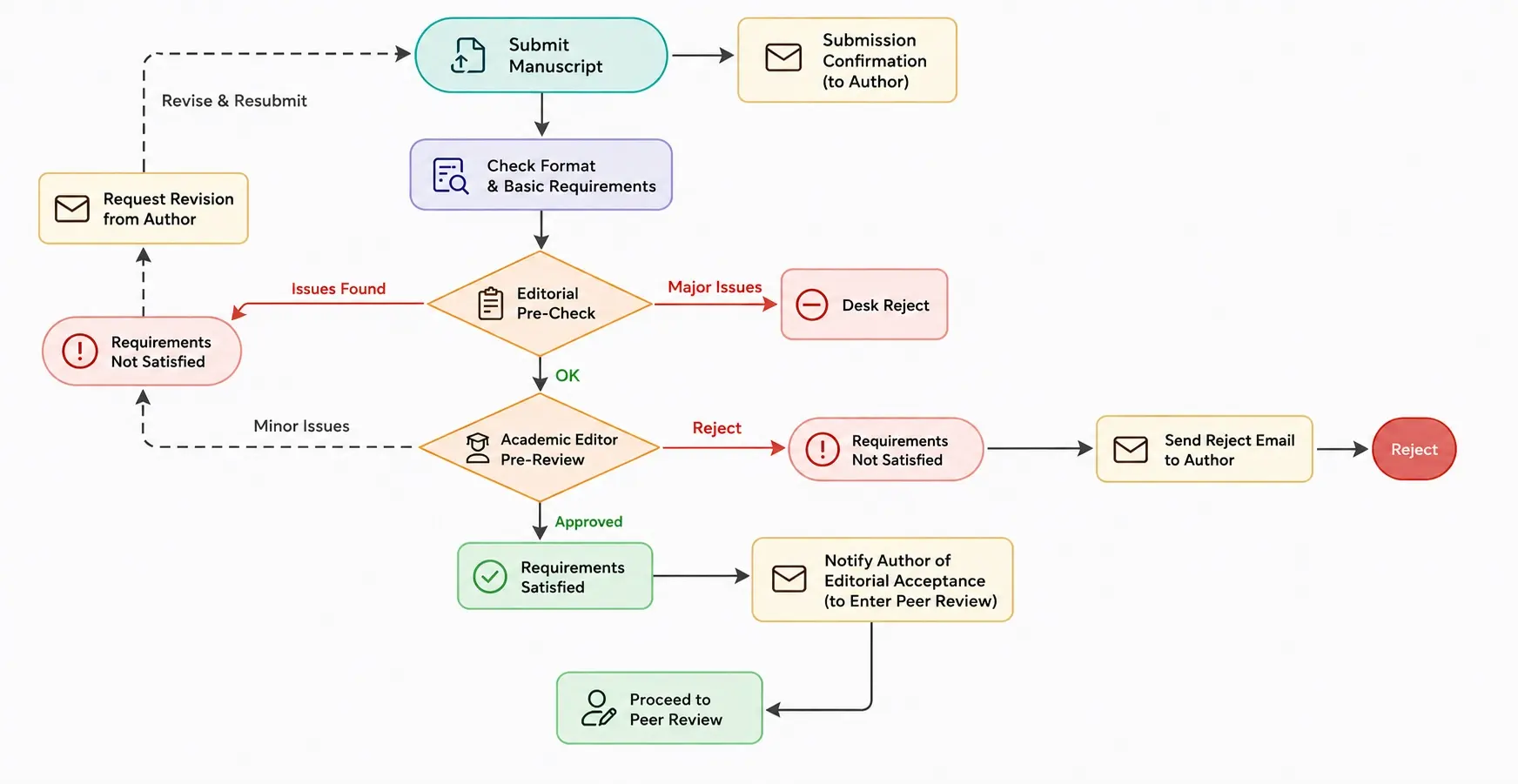
Upon submission, authors receive an automated confirmation. The editorial office then conducts technical checks (e.g., formatting, plagiarism screening, scope validation). Subsequently, an academic editor evaluates the manuscript's scientific merit. Only after passing both technical and academic pre-checks is the manuscript officially advanced to peer review.
A submission confirmation only acknowledges receipt by the system. Communication regarding "entry into peer review" should only occur after the manuscript successfully clears the technical and academic pre-review stages.
Peer Review Workflow
Once a manuscript passes the pre-check stages, it enters the formal peer review process. Academic Stack facilitates this through automated invitations, structured review forms, and clear communication channels between editors and reviewers.
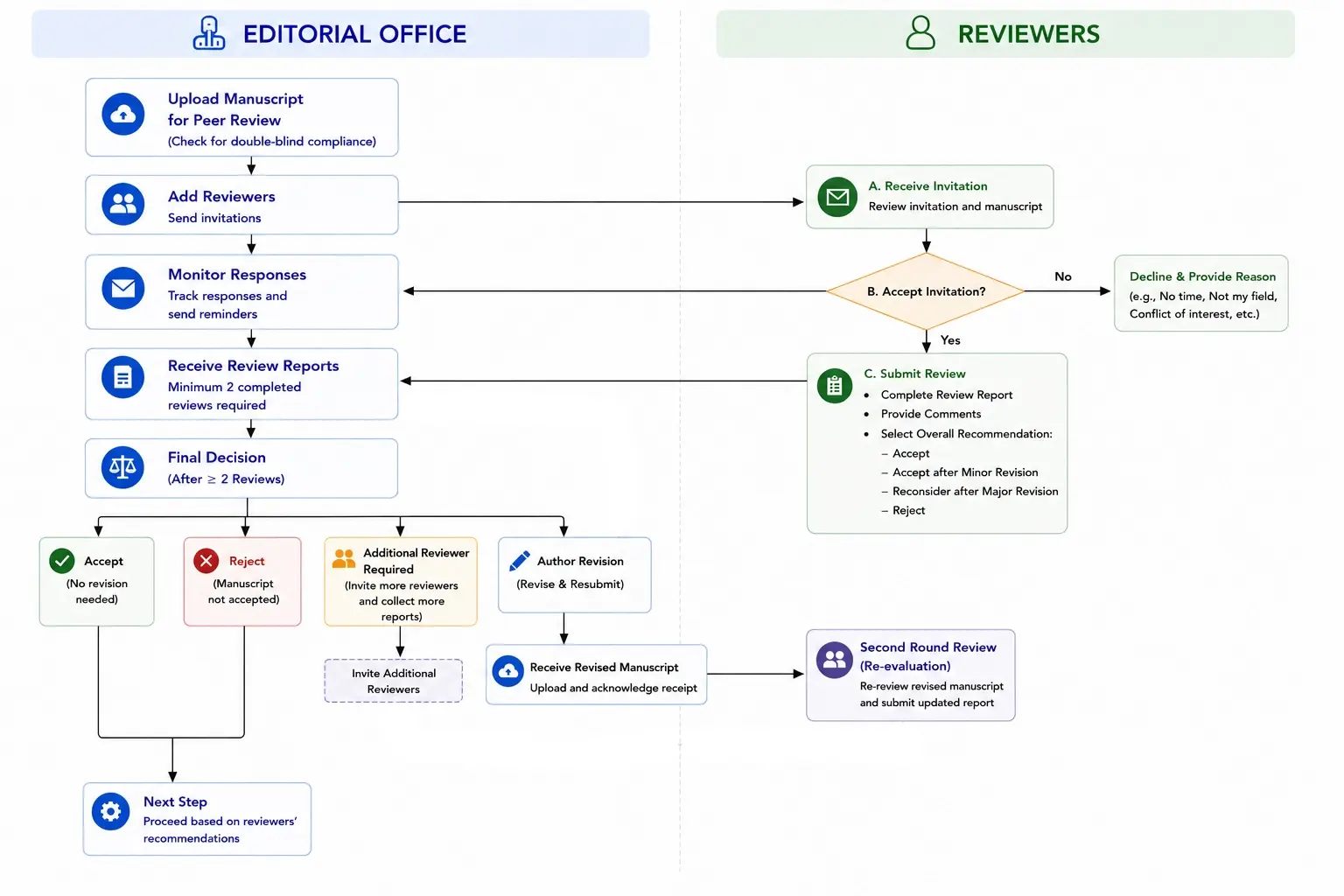
Editors can monitor the status of all invitations and reports in real-time, with the system handling automatic reminders and status updates to ensure the review timeline is maintained.
Production Workflow
Academic Stack provides a streamlined task management system for journals with dedicated production teams.
Assistant editors can transition accepted manuscripts to the production team, who manage their tasks from a dedicated list. Once work (such as typesetting or layout) is complete, they upload the final files and return the manuscript to the editorial office.
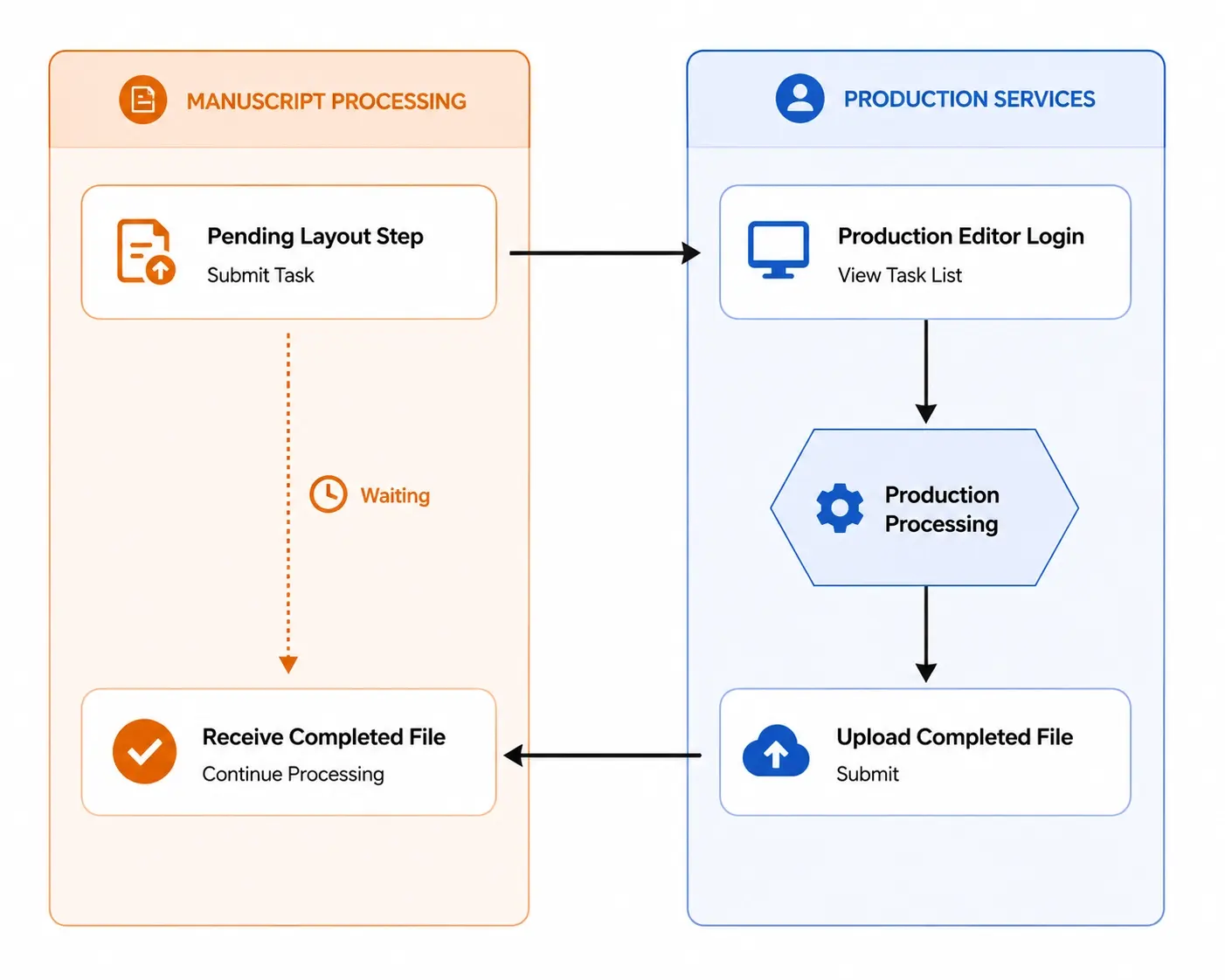
The production workflow is designed for task tracking and handoff management. The actual technical work—such as XML conversion, copyediting, and typesetting is performed offline using specialized tools by the production team or external vendors.
Smaller publishers without dedicated production staff can choose to skip this stage and manage final processing directly within the editorial office.
Configurable Workflow Logic
Academic Stack is designed with "configuration over customization" in mind. Publishers can adjust a wide range of settings to match their policies, such as:
- Toggling the requirement for peer review.
- Enabling/disabling author reviewer recommendations.
- Setting up academic editor pre-review steps.
- Configuring Automatic Reminders.
- Customizing post-acceptance production stages.
For complex requirements, Academic Stack supports JSON-based configuration backed by professional technical support. This ensures journals can implement highly specific workflows without the cost or delay of custom code development.
Key System Benefits
The Editorial Workflow module empowers publishers to:
- Minimize Manual Coordination: Reduce reliance on scattered emails and spreadsheets.
- Standardize Communication: Maintain professionalism through integrated templates.
- Enhance Stakeholder Experience: Provide clear, online interfaces for authors and reviewers.
- Ensure Accountability: Maintain a comprehensive audit trail for every manuscript.
- Maintain Flexibility: Easily adapt the workflow to evolving editorial policies.
- Unify the Ecosystem: Connect submission, review, production, and publication on one platform.
Summary
Academic Stack’s editorial workflow system combines the proven structures of scholarly publishing with the flexibility required by modern, diverse journals. By replacing fragmented offline coordination with a structured online environment, the platform helps publishers maintain high editorial standards while significantly improving operational efficiency.