Google Scholar Indexing
Google Scholar is a primary discovery channel for academic research. Academic Stack complies fully with Google Scholar's indexing guidelines, offering automated SEO and metadata optimizations out of the box to maximize your journal's visibility.
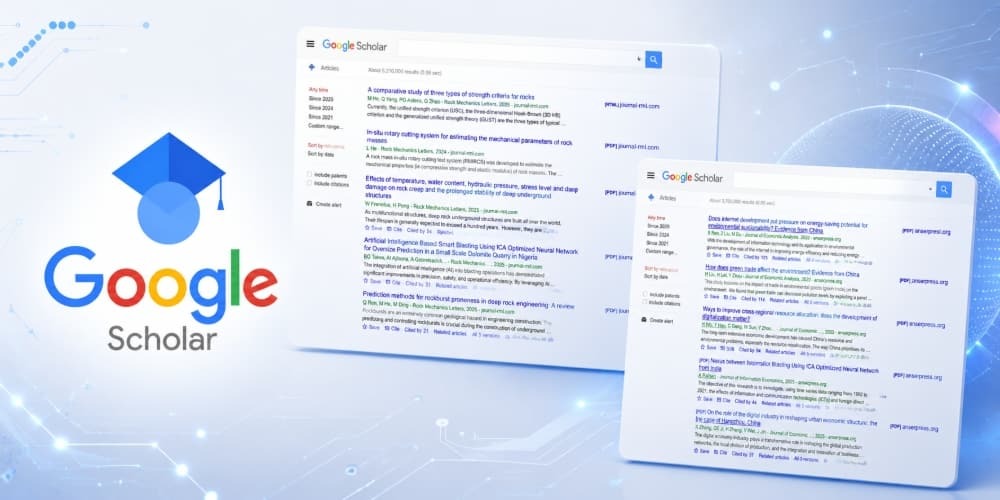
Academic Stack's SEO Optimizations
1. Automatic Scholarly Metadata Tagging
Google Scholar relies on bibliographic metadata embedded in the HTML <head> of article landing pages. Academic Stack automatically generates and injects these industry-standard tags for every published article:
- HighWire Press Tags: Includes
citation_title,citation_author,citation_publication_date,citation_journal_title,citation_volume,citation_issue,citation_firstpage,citation_lastpage,citation_pdf_url, andcitation_doi. - Dublin Core Tags: Provides equivalent
DCtags for broader library database compatibility. - Co-Author & Institution Mapping: Sequences multiple
citation_authorandcitation_author_institutiontags sequentially to preserve authorship relations.
2. Barrier-Free PDF Delivery
Google Scholar indexation requires crawlers to successfully download the full-text PDF.
- Direct Meta Tagging: Automatically binds the
citation_pdf_urltag to the direct PDF link. - No Crawler Blocks: Open Access PDFs are delivered with correct
Content-Type: application/pdfheaders, bypassing paywalls, CAPTCHAs, cookie prompts, or JS-based redirects that blockGooglebot-Scholar.
3. Structured References (Bibliography Parsing)
Google Scholar parses reference sections to calculate citation counts and link papers.
- Academic Stack wraps the bibliography in a semantic
<section>using clean list tags (<ol>or<ul>). - Formatted citations ensure Google Scholar's citation parser can accurately extract references and attribute citations to authors.
4. Persistent URL Structure
- Uses stable, clean permalinks (incorporating DOIs or clean slugs) for article landing pages.
- Employs permanent 301 redirects if domain changes occur to preserve search authority.
5. Dynamic XML Sitemaps & robots.txt
- Dynamic Sitemaps: Auto-updates XML sitemaps when new articles are published.
- Tailored robots.txt: Permits and prioritizes major academic indexing crawlers while restricting admin sections.
6. Google Search Console Integration
Allows publishers to configure site verification tokens (HTML tags/DNS codes) via the backend. Publishers can:
- Verify domain ownership.
- Manually submit XML sitemaps to accelerate crawl requests.
- Monitor search queries, crawl errors, and indexing status.
Best Practices for Publishers
- Enable HTTPS on a Custom Domain: A secure, custom domain is essential for crawler trust.
- Enterprise Version: Academic Stack provides free SSL configuration out of the box.
- Cloud PaaS Version: Refer to the Domain Binding & HTTPS guide for configuration.
- Accurate Article Metadata: Double-check authors, institutions, publication dates, and register active DOIs with Crossref.
- Open Access Access: Ensure article PDFs are publicly accessible without authentication.
Troubleshooting
- DOI Unregistered: Verify that the DOI is active and registered with Crossref.
- Crawler Block: Ensure firewalls (e.g., Cloudflare) do not block
Googlebot-Scholar. - Delay: Indexing typically takes between a few days to 4 weeks.